Why Your Environment Shapes Your Output
I used to think successful people had more discipline than me. More willpower. More drive. Then I started paying attention to where and around whom they worked — and I realized discipline was the smallest part of the story.
The short answer: your environment shapes your output more than your discipline does. Willpower leaks; surroundings don’t. Change where you work, what your phone shows you, and who is around you, and consistent output stops being a daily fight.
The biggest lever isn’t willpower. It’s environment. Your surroundings shape your behavior far more than your intentions do. I didn’t become consistent by trying harder. I became consistent by redesigning the world around me so that building was the path of least resistance.
The Willpower Myth
Willpower is a terrible strategy because it’s a depleting resource. Every decision to “be disciplined” costs mental energy. By evening — when most people with day jobs do their building — that energy is gone.
I learned this during my full-time years. I’d come home intending to work on Superpreneur Bangladesh, then spend two hours on my phone. I told myself I lacked discipline. The truth was simpler: my phone was next to me, my recording setup was packed away in a closet, and starting felt like a project.
The problem wasn’t my character. It was my environment. Starting required ten decisions and twenty minutes of setup. Not starting required zero. Guess which one won?
Friction: The Invisible Force
Every behavior has friction — the effort required to start it. High-friction good habits lose to low-friction bad habits, every time, regardless of your intentions.
So I stopped trying to increase my motivation and started decreasing friction for the behaviors I wanted:
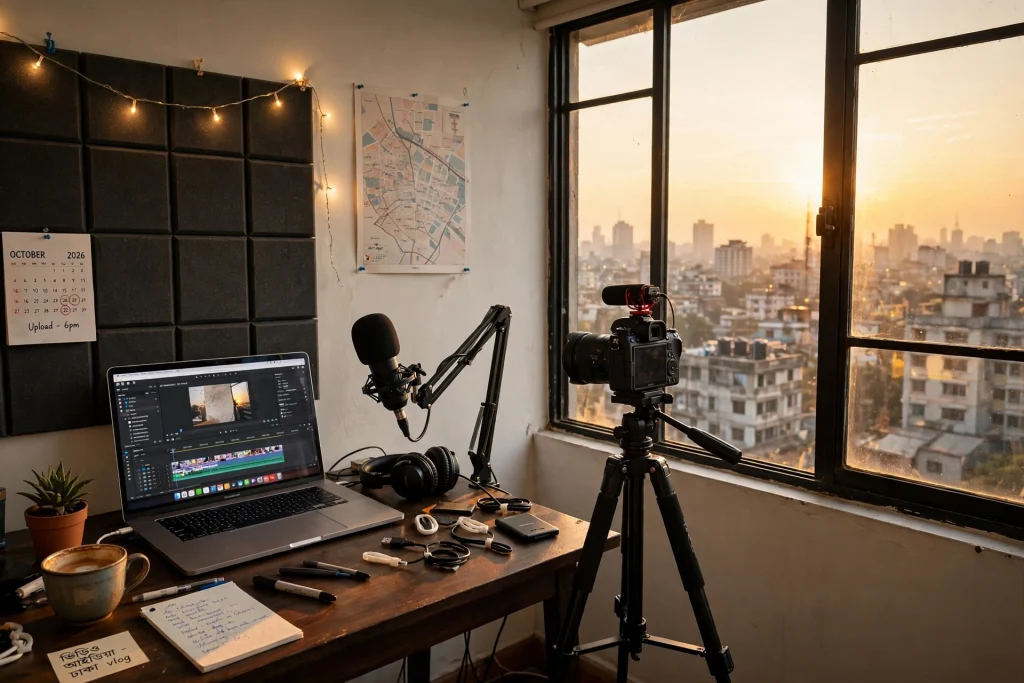
My recording setup stays ready. Camera on the tripod, mic plugged in, lights in position. I can start recording in 60 seconds. When setup took 20 minutes, I recorded twice a month. When it takes one minute, I record twice a week. Same person. Different friction.
My phone charges in another room. Not on willpower — on physics. To scroll, I’d have to get up and walk. That tiny barrier is enough. I didn’t become disciplined about my phone. I made my phone inconvenient.
My idea file is always open. One click, not five. The easier it is to capture an idea, the more ideas get captured. Friction kills more good ideas than criticism ever will.
The People Around You
Environment isn’t just physical. It’s social. The people around you set your normal.
When everyone around you watches TV every evening, building every evening feels weird. When everyone around you is building, not building feels weird. Same person, different normal.
I couldn’t change my whole social circle. But I could change my inputs: the creators I followed, the communities I joined, the conversations I consumed. I filled my feeds with builders. I joined groups where shipping was normal. Slowly, my “normal” shifted.
This is why I reply to comments and engage with my community seriously. I’m not just being nice — I’m trying to be part of your environment. If seeing someone in Dhaka build consistently makes your own building feel normal, then my consistency is doing double duty.
Design Principles
Here are the principles I use to design my environment:
1. Make good behaviors easy. Reduce every step between intention and action. The best habit is the one you can start in under a minute.
2. Make bad behaviors hard. Add friction to distractions. Log out of apps. Put the TV remote in a drawer. Use website blockers during building hours. You’re not weak for needing this — you’re smart for knowing how brains work.
3. Make cues visible. What you see is what you do. My content calendar is on my wall, not in an app. My book notes are on my desk, not in a folder. Visible cues trigger action without decisions.
4. Batch your contexts. I do deep work in the same place at the same time. My brain now associates that chair, that hour, with building. Context is a trigger — use it deliberately.
The Dhaka Reality
Let me be practical about constraints. Not everyone has a home office. Many builders in Bangladesh share rooms, deal with load-shedding, work around family noise.
Environment design isn’t about buying equipment. It’s about arrangement. A corner of a room that’s always set up beats a perfect studio you never use. Headphones beat silence you can’t get. A consistent 9 PM start time beats a perfect workspace.
Work with what you have. Arrange it deliberately. That’s environment design.
The Takeaway
Stop asking “how do I get more disciplined?” Start asking “how do I make the right action the easy action?”
You don’t rise to the level of your goals. You fall to the level of your environment. So build an environment that falls in the right direction.
Related reading:
- How to Think in Systems, Not Tasks
- My Morning Routine as a Builder with a Day Job
- How to Stay Consistent When Nobody’s Watching
Watch: More on building systems on the Superpreneur Bangladesh YouTube channel.