Why I Built Superpreneur Bangladesh: My Origin Story
Most people assume I started Superpreneur Bangladesh because I wanted to be a “guru.” The truth is much less glamorous. I started it because I was scared.
The Salary Trap
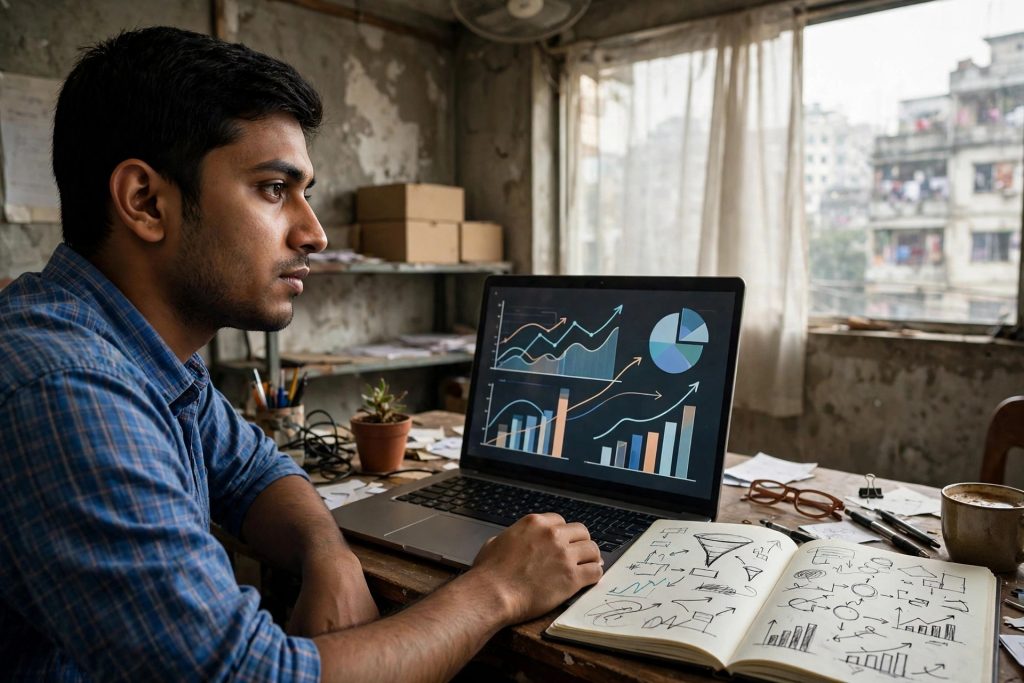
I spent years working full-time jobs in Dhaka. Grameenphone. Pathao. FrontStory. I learned digital marketing by doing it — SEO, ads, content, conversion. The skills were real, and the paycheck was steady.
But there was a quiet fear underneath: my entire income depended on one employer. If the company downsized, if my role became irrelevant, if I got sick for a month — everything stopped. That is not a complaint. Most Bangladeshi job holders live in the exact same fear, and most never say it out loud.
I don’t want to glamorize the struggle either. My jobs taught me everything I know. But they also taught me the ceiling: you can be excellent at your job and still have zero control over your income.
The Turning Point
Around 2020, I started noticing something. People at work would ask me the same questions over and over:
- “How do you know so much about ads?”
- “Can you teach me how websites rank on Google?”
- “I want to earn something extra, but I don’t know where to start.”
The same questions, every week, from smart people with real skills who felt stuck. And every piece of advice online was either in English, written for Americans, or told them to quit their job and “hustle.”
Quit your job? With rent due in Dhaka? With family depending on you? That advice wasn’t just unhelpful — it was insulting.
So I started recording videos. In Bangla. About practical things: how I think about online income, how digital products work, how a normal job holder could build something small on the side. No hype. No rented Lamborghinis. Just the stuff I actually knew.
That became the YouTube channel. The channel became a community. The community started asking for a system. That system became the Salary to Second Income framework. And the framework became Superpreneur Bangladesh.
Why "Superpreneur"?
The name is deliberate. I’m not building entrepreneurs — people who quit everything and bet the house. I’m building super-preneurs: people who keep their salary AND build an asset on the side.
A job holder with a digital product is more resilient than a job holder without one. That is the entire thesis. You don’t need to become a founder. You need to become someone with two income streams instead of one.
What I Refuse to Do
Let me be blunt about what Superpreneur Bangladesh is NOT:
- Not a get-rich-quick scheme. If you want passive income by next Friday, leave.
- Not English-first guru content. I teach in Bangla because that’s who I serve.
- Not theory. Everything I teach, I’ve either done myself or studied deeply from people who have.
The online income space in Bangladesh is full of noise — screenshots of fake earnings, rented offices for photo shoots, “DM me for the secret.” I built Superpreneur Bangladesh as the opposite of that: slow, honest, practical.
What It Has Become
Today, Superpreneur Bangladesh is a platform with:
- A Bangla blog at superpreneur.bd with pillar guides on second income, side business, ebooks, and digital products
- An English site at superpreneurbangladesh.com for broader audiences and the diaspora
- A YouTube channel (@superpreneurbd) with hundreds of practical videos
- The Salary to Second Income framework that ties it all together
I explain the full framework in detail here: The Salary to Second Income Framework Explained.
The Mission Going Forward
I want every Bangladeshi job holder who searches for “second income” or “side business” to find something real — not hype, not scams, but a practical path they can follow in 1–2 hours a day.
That’s why I built it. That’s why I keep building it.
What Building It Taught Me About Myself
Here’s something I didn’t expect: building Superpreneur Bangladesh changed how I see my own career.
For years, I thought of myself as an employee who happened to know marketing. Now I think of myself as a builder who happens to have a job. That shift matters because it changed my relationship with risk.
When your identity is “employee,” any side project feels like a distraction. When your identity is “builder,” your job becomes fuel — it funds the building, it teaches you skills, it gives you real-world problems to solve. The job didn’t become the enemy. It became the launchpad.
I also learned that teaching is the fastest way to learn. Every time I explain a concept in a video or article, I understand it better myself. My marketing skills improved *because* I started teaching, not before. If you’re waiting until you’re “expert enough” to teach, you’re waiting backwards.
The Hard Parts Nobody Sees
Building in public while holding a full-time job is not glamorous:
- Time. Everything happens in the margins — early mornings, late nights, weekends. There’s no “finding time.” There’s only taking it.
- Doubt. For months, the channel grew slowly. Friends asked when I’d “get serious.” The numbers didn’t justify the effort — until suddenly they started to.
- Consistency. Publishing when nobody’s watching is the hardest discipline. You do it on faith that compounding works. (It does, but faith is required in the gap.)
I’m sharing this because the origin story isn’t “I had a vision and executed flawlessly.” It’s “I was scared, I started small, I kept going, and it compounded.”
If you’re a job holder wondering where to start, watch my videos on YouTube or read the guides on superpreneur.bd. Start with what you already know. The framework handles the rest.
Building in public means the criticism arrives in public too. Here is how I handle criticism as a creator.
Superpreneur is what it looks like when one person actually runs the playbook: from employee to authority — my 5-year playbook.
And the question underneath the whole project: the legacy question — what are you building for?
Where all of this is heading next: my 2027 outlook for the Bangladesh creator economy.
I wrote honestly about the hardest part of building it in the loneliness of building something new. And the channel that holds the whole project together is the list: building an email list in Bangladesh (without ads).
I mapped the landscape this project competes in here: the Bangladeshi creator economy in 2026. And the asset it all rests on is not reach — it is the difference between an audience and a community.
Building in public also means building in front of the people closest to you. Here is how I handled building when my family didn’t understand — the questions, the doubt, and what slowly changed it.