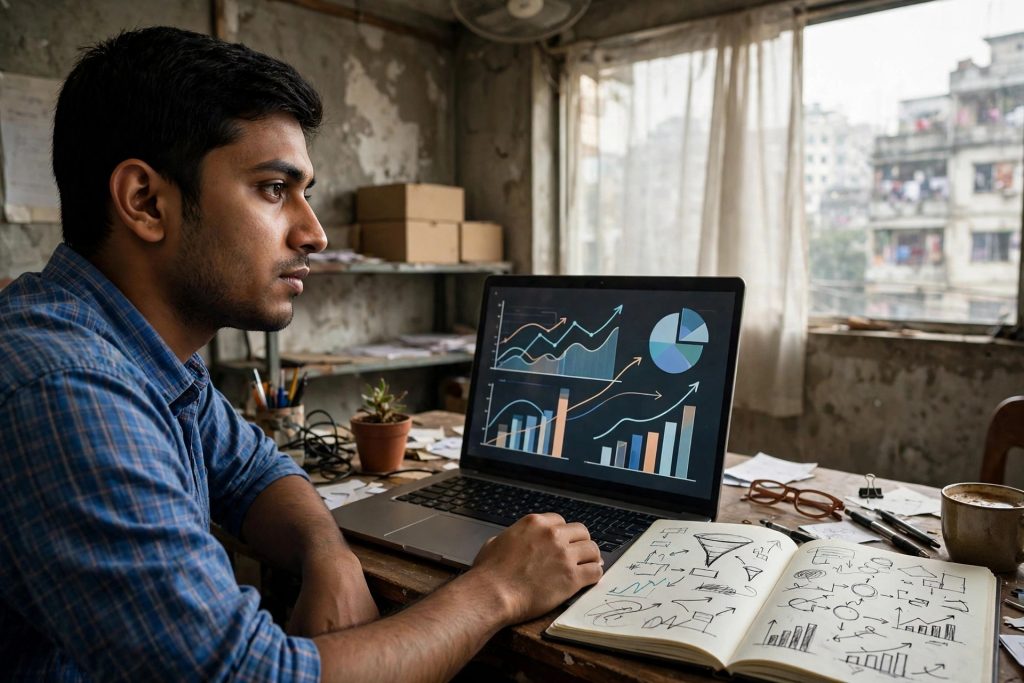
The short answer: AI didn’t replace my judgement — it replaced my blank page. Research, outlining and first drafts that used to eat a whole weekend now take hours, so I publish more and promote properly. What AI did not change: the ideas, the experience and the final edit are still mine.
A few years ago, publishing one good article took me an entire weekend. Research on Friday night, outline on Saturday morning, drafting through Saturday evening, editing on Sunday, and by Sunday night I was too tired to promote it. One piece of content. One whole weekend. Gone.
Today I publish multiple times a week — articles, scripts, posts — alongside a full-time job. The difference isn’t that I work longer hours. It’s that AI rebuilt my workflow from the ground up, and most people still use it like a slightly smarter search engine.
Here’s the honest before-and-after.
The Old Workflow (Slow, Fragile, Exhausting)
My old process had five stages, and every one of them was a bottleneck:
- Research: Hours of reading, scattered notes in three different apps, half of which I’d never find again.
- Outlining: Staring at a blank page, trying to impose structure on a pile of disconnected facts.
- Drafting: The slowest part. Translating thoughts into sentences is cognitively expensive, and I did it all manually.
- Editing: Reading my own draft with fresh eyes the next day, fixing structure, cutting fluff.
- Repurposing: This almost never happened. I was too drained after publishing to turn one article into five posts.
The result: I published when I had energy, which was inconsistent. I’ve written about this in My Content System: How I Never Run Out of Ideas — the system mattered more than motivation, but even the best system had a speed limit: me.
The New Workflow (Fast, Layered, Sustainable)
AI didn’t replace a single stage. It changed *every* stage:
1. Research → Conversation. Instead of reading ten articles and taking notes, I now have a working session with AI: I dump my raw questions, it synthesizes background, and I interrogate it. “What am I missing? What’s the counterargument? What would a skeptic say?” The research phase went from 3 hours to 45 minutes — and it’s *better* research, because I’m arguing with a sparring partner instead of passively consuming.
2. Outlining → Co-design. I bring AI my messy brain-dump and we build the skeleton together. I always do the final structure myself — that’s a judgment call — but going from chaos to outline used to take an hour of painful staring. Now it takes fifteen minutes of dialogue.
3. Drafting → Directed writing. This is the biggest shift. I no longer write from a blank page. I write *through* AI: I dictate my raw thoughts — often messy, in mixed Bangla and English — and AI shapes them into clean first drafts. Then I rewrite the important parts in my own voice. The draft exists in minutes; the craft happens in the rewrite. Most people get this backwards: they let AI write and then lightly edit. That’s how you get generic content. The rule is: AI drafts, I decide.
4. Editing → Ruthless pass. Editing is where my voice lives, so I never fully delegate it. But AI is excellent at the mechanical layer: catching repetition, flagging weak transitions, checking that my H2s actually deliver what the intro promised. It handles the boring 60% of editing so I can spend my energy on the judgment-heavy 40%.
5. Repurposing → Automatic. This is where the multiplier effect lives. One article now becomes: a YouTube script outline, five social posts, an email, and a set of FAQs. I described the philosophy in Content Repurposing: One Idea, Five Platforms — AI made the philosophy *executable* without a team. What used to be a “someday” task now happens in the same sitting.
What AI Did NOT Change
Let me be clear about what stayed human, because this is where most AI content advice goes wrong:
Ideas are still mine. AI has never once given me an idea I was proud of. It remixes; it doesn’t originate. Every article starts with something I actually thought, observed, or lived. AI is the amplifier, not the source.
Judgment is still mine. “Is this true? Is this useful? Would I stand behind this?” — AI can’t answer those. It will confidently generate plausible nonsense. Every claim that matters gets verified by me, not by the machine.
Stories are still mine. My experiences at Grameenphone, Pathao, FrontStory — the failures, the lessons, the specific moments — no AI can generate those. And they’re the reason people trust my content. Generic advice is free everywhere; lived experience is the moat.
The final call is still mine. Publish or not? This angle or that one? Tone it down or push harder? These are taste decisions, and taste is the last thing AI will learn.
The Honest Math
Here’s what the workflow change actually bought me: I went from one piece of content per weekend to a sustainable rhythm of multiple pieces per week, without working more hours. AI didn’t make me faster at *thinking* — it made me faster at everything *around* thinking.
And here’s the part people miss: the workflow change compounded. More output meant more feedback, more feedback meant faster learning, faster learning meant better ideas. AI didn’t just speed up my production line — it sped up my entire learning loop. That’s the real story, and it’s why I wrote Why I Embraced AI Early.
What This Means for You
You don’t need my exact workflow. You need the principle: stop using AI as a search engine and start using it as a workflow layer. Pick your slowest stage — for most people it’s drafting or repurposing — and rebuild just that stage first. Get the win. Then expand.
The creators who thrive in the next few years won’t be the ones who avoid AI or the ones who let AI write everything. They’ll be the ones who rebuilt their workflows around a simple truth: the human does the thinking, the machine does the typing.
I’ve been building that workflow in public. If you want to see it applied to Bangla content for Bangladeshi builders, that’s what I do every week: @superpreneurbd
*I’m building my version of success in public — and helping Bangladeshi job holders build theirs. Join the journey in Bangla: @superpreneurbd*
Where this is heading next: my prediction for AI and creators in 2027.
Two companion reads: the research step inside this workflow — how I research keywords for Bangla content — and what this way of working adds up to: AI didn’t replace me — it multiplied me.
This workflow is my bet on where things are heading. The bigger picture: my 2027 outlook for the Bangladesh creator economy.
A workflow is only half of it — the output still has to sound like you. Here is how to stay authentic while using AI.
New to all of this? Start one step earlier: how beginners should approach AI tools.